Co-design
We co-design people-centred programs and services that make an impact.
Engage us as your co-design partner
We get it. Engaging a co-design partner is a big deal.
Learn about the fundamentals of co-design and our approach to a typical co-design project in our online course, assess your organisation’s readiness for co-design via our readiness assessment, and understand the costs associated with engaging a co-design consultant via the cost calculator.
When you are ready to chat, reach out and book a time to meet with our team so we can learn more about your next co-design project.
What is ‘co-design’?
We like to keep things simple here at Beacon Strategies.
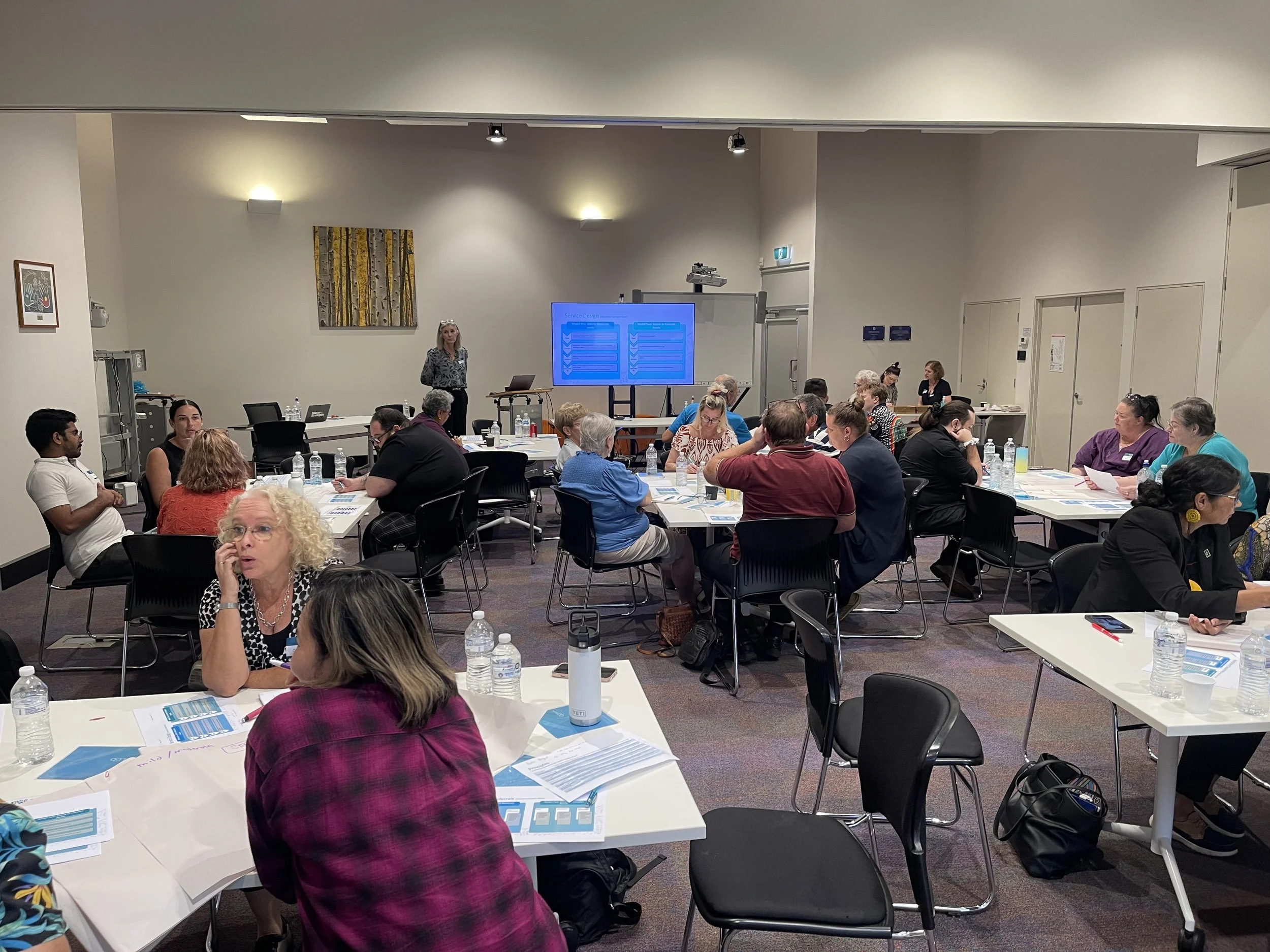
Co-design to us is working with the people who directly use a program or service to design a response that meets their needs — and then working with funders and service providers to make it happen.
Our co-design partners
We specialise in co-designing programs and services within the health and community services sector.
We co-design programs and services within the health sector, working alongside Primary Health Networks, Local Health Networks and Government in their role of planning, delivering or commissioning health services to meet the needs of their communities.
We support not-for-profit organisations (both large and small) in the community services sector to co-design their programs and services to make a lasting impact.
Across our sectors, our co-design experience spans subject matter areas such as mental health, suicide prevention, primary health care, secondary health care, social inclusion, chronic disease and child and family wellbeing.
We’ve been trusted to co-design with…
Recently completed co-design projects

Take the next step in your co-design journey
Learn co-design fundamentals
Understand the foundations of co-design and learn about a typical co-design process through our ‘Co-design Fundamentals’ online course.
Asses co-design readiness
Understand if you and your organisation are ready to undertake your next co-design initiative by taking our organisational co-design readiness assessment.

Understand co-design costs
Estimate the investment required for engaging a co-design consultant for your next project by using our co-design cost calculator.

Reach out for support
Book a time to get to know us and discuss how we can help you to deliver your next co-design project. Get all of your questions answered, obligation free.
Our co-design approach in more detail
Our co-design process
Our methods follow tried and tested co-design methods that align with leading co-design frameworks such as Experience-Based Co-Design (EBCD) and Human Centred Design (HCD). Our focus on health equity and community involvement ensures that our co-design work is designed with vulnerable populations in mind.
We begin by working intensively with you.
We set up fit-for-purpose governance arrangements, develop a transparent co-design plan and collaborate to understand your context and the opportunity.
Engage widely with external stakeholders.
We collect feedback from stakeholders outside of the co-design process through surveys and webinars to validate, refine and add credibility to the process.
Leverage existing knowledge through desktop research.
We review your strategic and operational context, use data to assess local needs and look at comparable models from elsewhere for inspiration.
Work together to move from ‘issue’ to ‘solution’.
We work closely with you to interpret co-design outcomes, refine service models accordingly, and use additional research to fill knowledge gaps.
Engage deeply with co-design participants.
We use proven co-design methods to meaningfully understand user experiences, needs, challenges and potential solutions from consumers and professionals.
Generate useful co-design reporting products.
We provide comprehensive reports, tailored summaries, and actionable advice to support service model design, re-design or commissioning activities.
Iteratively develop service models.
We create service model prototypes based on co-design insights to spark purposeful discussions and move the conversation forward.

We’ll maintain your confidence along the way.
Throughout the journey, we employ a disciplined approach to adhere to timelines and budgets, maintain close partnerships, and keep communication transparent.
Co-design blogs

While 'care pathway' is a commonly used term, there are many different definitions and types of pathway that exist. We look at what a care pathway is, how to develop one and some case studies.
The term 'service model' can be ambiguous and means different things to different people. It could be a one-page infographic or a 100-page program manual. Let’s walk through the most common ones we see.
This blog is dedicated to developing a co-design project plan that offers a flexible framework for delivering your co-design project. It covers the three main elements necessary for your co-design project.
Beneath a carefully planned and executed co-design session lies a purposeful process designed to achieve specific results. Follow this step-by-step guide to develop your own co-design process.
Explore what co-design looks like in the PHN commissioning context when compared to the service provider context and understand how the Department of Health and Ageing has directed PHNs to use co-design. Plus several co-design toolkits for PHNs.
In the not-for-profit sector, effective co-design is not only a concept but a strategic approach that can significantly enhance service delivery and impact. The Co-design Toolkit from Western Australia, published in 2017, has proven to be an invaluable resource for not-for-profits.
In this blog we'll outline the key elements of EBCD, point you in the direction of three resources that will help you get started and give you some insight on how we've used EBCD here at Beacon Strategies.
This blog explores co-design in healthcare, covering national/state frameworks, regional guidelines, and our perspective on designing healthcare solutions.
This blog unpacks the common features of co-design according to leading experts, including its broad applicability, inclusive participation, equal decision-making, active engagement, and focus on implementation.
Collaborating with diverse voices to create real-world solutions while being transparent and building capabilities fosters meaningful involvement and better outcomes. Discover how co-design enhances idea generation, services, and outcomes.
Today, we're putting the spotlight on two Bradshaws - Carrie, the ever-fashionable protagonist of "Sex and the City," and Jonathan, the British scholar who introduced the Taxonomy of Needs. How do these two relate? Read on to find out…
Journey mapping can be used to design or refine your programs and services in order to provide your clients with a better experience, and to help you understand what your client is doing, thinking, and feeling during their ‘journey,’ when using your service. We explain what’s involved in client journey mapping and why you should do it.
What is co-design and why should we use it? As discussed in our last blog, co-design is a form of human-centric design which basically means collaborating with people. Now, let's talk about the 4 key elements of co-design and guiding principles.
Co-design is quite topical in the health and social services sectors and there can be some confusion about what co-design is, and probably more so what it isn’t and what is involved in a true co-design process. Actually breaking down the word ‘co-design’ can help to develop a clear understanding of what it is.
The good news is that with a bit of space, time and well thought through process design, undertaking a customer journey mapping process isn’t unattainable for a not-for-profit organisation to deliver effectively. To help get you started, we’ve outlined a common customer journey mapping process that we have used successfully across a number of previous projects.
Moving from a position of mobilising general support for the concepts towards the uptake and implementation of social prescribing elements is the challenge. There are significant opportunities to enhance the uptake of social prescribing in local communities and health systems right across Australia, with PHNs having a particularly profound opportunity to lead the charge.
In considering what ‘good’ looks like in the context of social prescribing, we should start with why it’s not already happening. It seems logical to focus on a person’s health and social needs and from the work we’ve done with consumers and health professionals, there is shared recognition of the importance and need for something like social prescribing.
With the continued focus on social prescribing as a ‘high-value, low-cost’ way of improving the responsiveness of the health system, we thought it would be worthwhile to unpack some of what we learnt in that project to share with other PHNs commissioning social prescribing service models or linkage program providers. This blog is the first of three in a South Eastern NSW case study series: what is social prescribing?
Recently, our team has closed out a number of PHN specific design projects. As a means of providing value for our PHN colleagues, we thought we would share some specific service design insights and tips for you to consider before running your next service design process.
Any provider of health and social services should regularly review their service models against the latest evidence, policy priorities and practice guidance. The following blog explores the inputs we use to inform service redesign and create "implementation ready" service models. Read more here.
Needs assessment is a term that you have most likely heard of if you work for a local government or council. However, what exactly is it, why should you consider conducting one and what is the best approach?
The Buurtzorg Model has transformed community-based aged nursing in the Netherlands, at scale, to keep older adults healthy and out of hospital. But can the Buurtzorg Model be translated to the Australian context? Is it possible to reverse or better leverage the trend of an increasingly non-clinical in-home aged care workforce? How do we shift from delivering aged care services transactionally to relationally?
Market-led approaches to health and social services are considered to be a responsive, innovative and efficient mechanism in meeting the needs of consumers. At Beacon Strategies we were lucky enough to join one of our partner organisations for the journey.
One of our key projects during the second half of 2017 was to support a client in planning their expansion into Queensland. In this article, we describe the steps we undertook, what we found, and how a similar approach can help ensure organisations considering expansion to do so successfully.
We were engaged by Acacia Ridge Community Support Inc (ARCSI) to co-design a service model of community-based antenatal care coordination for the Acacia Ridge and nearby communities. A few weeks ago, we proudly presented the findings of this service design process at a workshop led by ARCSI and attended by a range of interested stakeholders.
Today's blog post is going to cover a piece of work we are currently doing in collaboration with Acacia Ridge Community Support Inc! For those not familiar with what 'service mapping' is, it is essentially a stocktake of available services in the local community to better understand what is available.
Midway through this year, we were engaged by Acacia Ridge Community Support Inc. to complete a community needs assessment and service design project focussing on the prenatal period as a key time to influence the trajectory of one's lifelong health and prosperity.
It's been a busy couple of months here at Beacon HQ but we thought it might be good to share a tale from our travels.